Preparation builds confidence. What it cannot do is replicate the conditions that will genuinely test you.
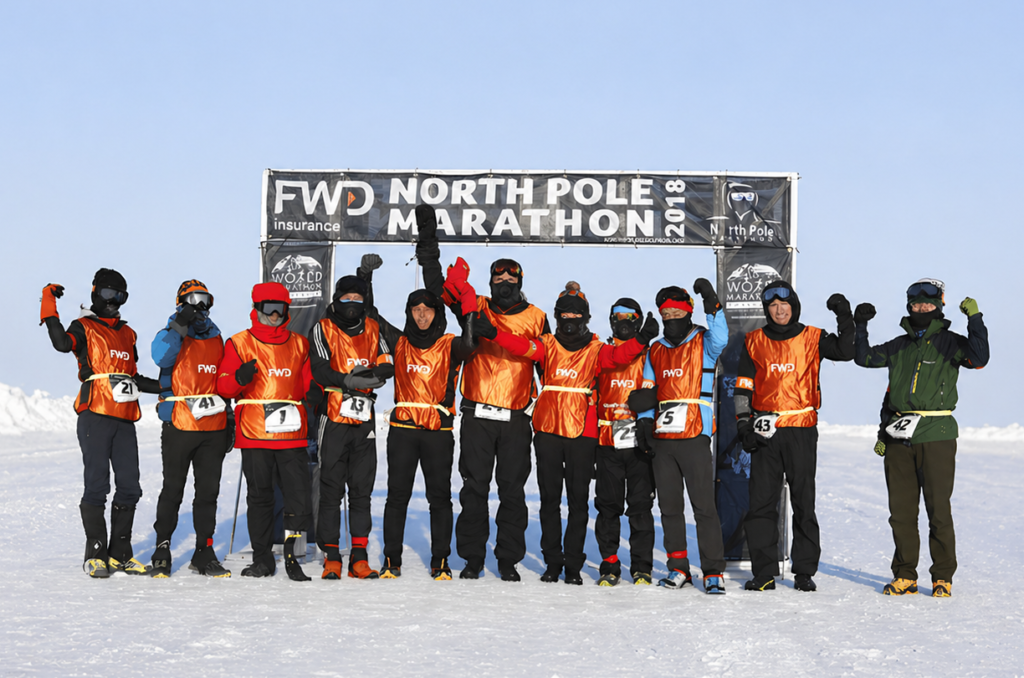
In 2018, I ran the North Pole Marathon as part of the FWD team, a group of runners from across Asia with diverse backgrounds. We trained separately, came together in Norway, and then the race showed us things no preparation had anticipated.
On paper, the team’s credentials were hard to question. Wing Keung Chik had run seven marathons on seven continents in seven days. Siu Wai Leung held multiple Hong Kong records in the visually impaired category and had completed a 100-kilometer ultramarathon in Antarctica. Shariff Abdullah had qualified for the Boston Marathon as an amputee. Ben Scully, our most senior teammate in his 50s, carried 36 marathons and 12 ultras of accumulated experience to the ice. What none of that prepared us for was what the Arctic had in store.
With ten kilometers left, my feet started going numb. The shoes I packed were not engineered for that level of sustained cold, and by the time I reached the transition tent, I could no longer rely on them to continue. Ben had already finished and was waiting when I arrived. He recognized the problem, offered his shoes, and I kept going. What made that possible was not generosity alone but a composure that prevents a manageable problem from becoming something it does not need to be.
Shariff’s prosthetic blade kept sinking into the snow with each stride, making every step more difficult than the last. He chose to complete the half marathon distance instead of the full. For someone with his competitive history, that required genuine self-awareness, because everything in his background argued for pushing through. He assessed the situation honestly rather than optimistically.
Siu Wai covered the full course tied to Wing Keung, who navigated the terrain ahead and held their coordination intact across every loop. What carried them through was not endurance alone but a mutual attentiveness that pressure is specifically designed to erode.
None of us ran the race we had trained for. What each of us had to do was face what was actually in front of us and respond to that, not to the plan we arrived with. The instinct under pressure is to push harder, act faster, or do something visible just to feel in control. Composure is what interrupts those defaults before they take over.
Resilience research defines composure as the ability to regulate your emotions under stress well enough to stay focused on what the situation requires. It is not about suppressing what you feel. It is about keeping your emotions from driving the decision. Ben’s experience let him act without hesitation. Shariff’s self-awareness let him stop without shame. Siu Wai and Wing Keung’s trust in each other kept them coordinated when everything around them made it harder. Each response looked different, but each came from the same discipline.
That discipline is not a fixed trait. It can be built, and it is most decisive when conditions are hardest. The race simply makes it visible. So does the rest of life.